A friend invited me to join her on a hike and I said yes! We traveled with about 20 fellow international school parents to hike the mountains near the YeXian pagoda in Miyun District, Beijing. In Beijing, one can travel quite a long time and still be within Beijing’s borders! Since we can’t really travel outside of Beijing right now, I’m thankful we can head up into the hills (or into the city) to explore!
About 1.5 hours from home, we arrived at the visitor’s entrance gate to the mountain/site. Near the entrance, there were religious/cultural statues, beautiful gates, and temples. I’m not sure what religions were represented, possibly Hinduism. There was an altar for those who wanted to burn incense and pray. We trekked up the steps of the mountain, chatting most of the way. Some rested on the switchbacks while others continued hiking to the top. When we got to the pagoda, I chose to hike all the way to the top where there were a few more architectural pieces–a few more pagodas, arches, and a big marble bridge at the tippy top. The uppermost walkway was a recreated Great Wall, which made us chuckle! After having lunch and time to explore the top of the mountain, we gathered up, strapped on protective gear (helmets + elbow/knee pads) and go-carted (gravity powered) down! It was quite a fun and bumpy ride down!
Finally, after living in Beijing for several months, we made our way to Beijing’s signature tourist attraction: the Forbidden City.
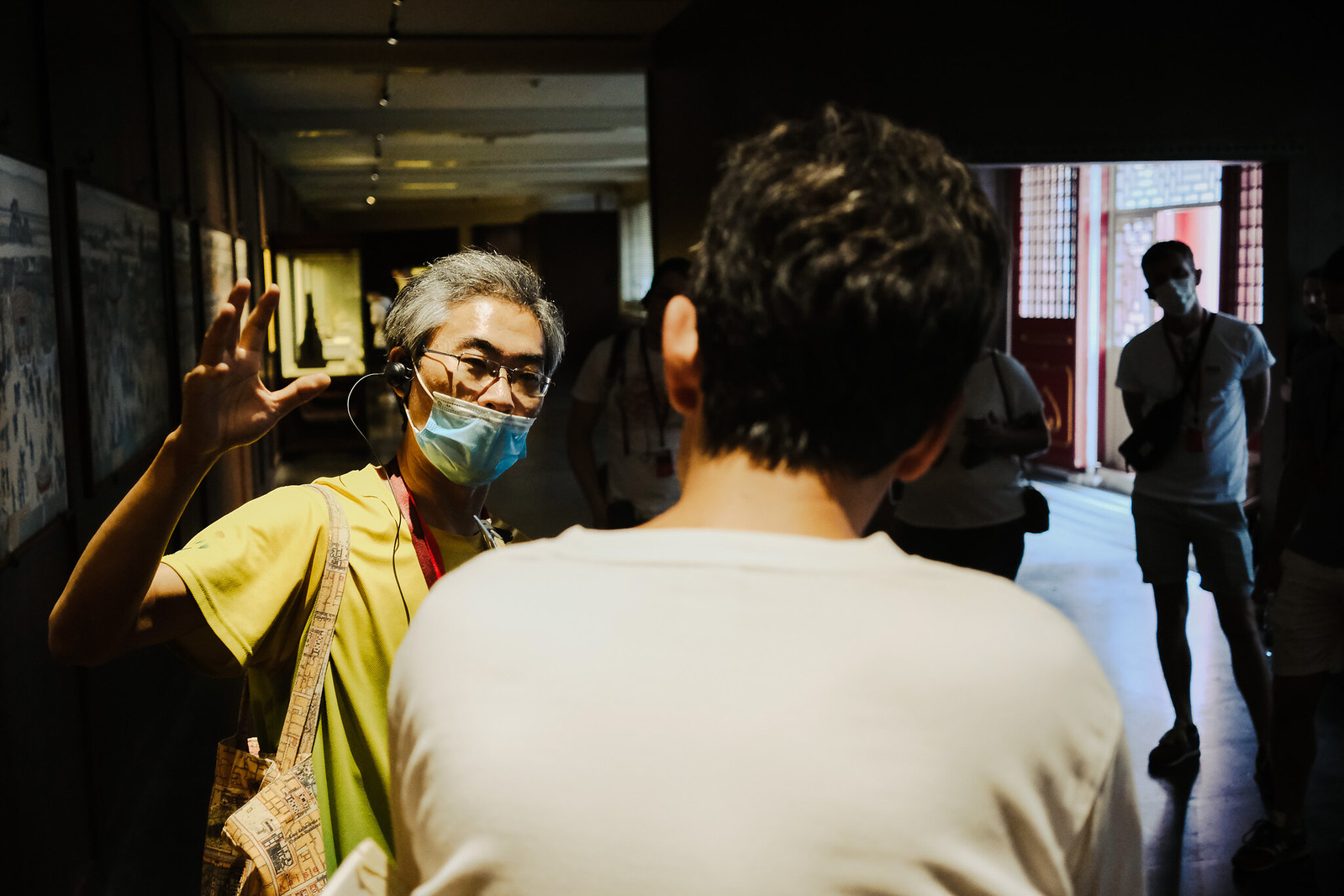
We decided to take a tour with Beijing Postcards, a history-focused company that offers tours and other experiences based on original research into Beijing’s history.
Getting to the Forbidden City presented obstacles typical of being in a new country with limited language skills and `experience. For some reason, I was able to hail a ride in Chinese using Lisa’s phone, but I wasn’t able to call a car using my phone. When we finally got there, we were late for our tour.
Despite all the difficulties, it was magnificent to see one of Beijing’s signature pieces of history, and to learn from a tour guide who both loves his job and is currently engaged in unearthing China’s fascinating history. We’ll definitely be back to the Forbidden City!
(Click on any picture below to launch the slideshow view and enjoy the photos!)
If you grew up in the 80’s and loved television (howdy, fellow Gen-X’ers!), there’s a decent chance you watched Adventures of the Gummi Bears. If you weren’t savvy and determined enough to record live TV on VHS tapes, this show has faded into the mists of your 80’s childhood nostalgia, along with Reebok Pumps and weekend Blockbuster runs.
Luckily, Ready Player One isn’t the only party cashing in on your midlife income and your craving to foist your childhood memories on the next generation. Disney+ (the OG Plus [yes, Paramount, Hulu, and Peacock – that was a diss]), has thrown open the vaunted Disney Vault to bring back such quality programming as Mr. Boogedy and Chip N Dale Rescue Rangers.
One surprisingly pleasant discovery was Gummi Bears, which I, in my childhood obliviousness, didn’t even encode as a Disney property. As with all things half-remembered from childhood and rediscovered in adulthood, there was a lot more going on than I realized at the time.
The sheer ambition of Gummi Bears’s writers/creators is impressive. Consider the elements that it attempts to pack in:
Anthropomorphic bears based on an iconic candy
A child-hero bear with no special skills meant to be an avatar of the viewer
A young, empowered preteen female heroine bear who wants to be a singing star but lacks the voice for it
An old, wise, wizard bear
A matronly bear figure that keeps all the bears in line with stern glances and sharp rebukes
A manly builder-bear meant to reinforce 80’s American masculine stereotypes, often supporting but occasionally mocking them
A fat bear called Tummi Gummi who is voiced by the actor from Garfield, and who apparently shares Garfield’s single-minded comical focus on the next meal
Dragons, but not scary ones
Ogres that serve as comic villains
Castles
Knights and knight paraphernalia a la Dungeons and Dragons
Princesses
Ancient advanced technology
Moral lessons that are sufficiently religious-distant to encode 80’s publick morality
A robber-baron knight villain with an overly enthusiastic British-adjacent accent, meant to engender a subtle disdain of high-class culture that was so often seen in the 80’s (see: MacGyver’s folksy humility)
A class-misfit human child who is in love with a princess, who is the only true believer in the Gummi Bears, and who benefits from the combination of their mythical status and his special knowledge of them
Awkward pre-teen love plot lines
Gummi Berry Juice
Ancient Lore
The ancient lore, discovered by both the viewers and the show’s characters at the same time, becomes a reusable deus ex machina, allowing the show’s writers to insert magic to alter the Gummi’s abilities and pull them out of whatever sticky jam (pun unapologetically intended) they may be in.
The theme song is worthy of mention, because it’s an awkward masterpiece in itself. It attempts to lay out all the elements of the show, unintentionally becoming almost comical in its thematic whiplash. But the best part is a near-religious soaring vocal track that, even in my childhood, seemed inappropriately passionate to be used on cartoon-mythical-candy-bears. I dare you to watch it in the video below and find yourself embarrassed as you try to refrain from whistling it for the rest of the day.
Watching the show with my kids has been a fun return to my own childhood, and has allowed me to see and appreciate the times in which I grew up with the perspective of distance.
Did you watch the Adventures of the Gummi Bears? Are there any other old movies or TV shows that you’ve rediscovered?
Today’s snowstorm in Washington (and the DMV area) is a fun treat for our California-bred kids. For them, snow is something to visit in the mountains in the winter, not a reality to live and play with every day. This morning Joshua and Caleb dragged me to the park to enjoy the magic of the freshest hours of a snowy weekend morning.
(Tip: Click on a photo to open it in a larger carousel view.)
Mix together in a small bowl + let sit until the yeast is frothy.
1 heaping tablespoons yeast
½ cup lukewarm water
1 teaspoon sugar
In a saucepan/pot, heat milk. (I usually use whole milk.) Take off the heat before it boils. Don’t let it boil!
3 cups milk
In a mixing bowl, combine the following:
1 cup flour
1 cup soft butter @ room temperature
1 tablespoon salt
Once the butter/flour/salt mixture is blended + milk is heated, alternate adding milk + flour to the mixing bowl making sure the milk is completely blended with each addition.
Add the yeast mixture to the dough + fully incorporate it. Add more flour until the dough pulls away from the sides + is just a bit sticky. Knead dough until the dough is smooth.
about 8 cups of flour will be used
Cover and let rise once for about 1 – 1 ½ hours in a warm place until it is double in size.
Heat oven to 375oF.
Pinch zwieback + set on greased or parchment-lined pans, cover + let rise for about 30 minutes. (This is usually the time it takes to pinch out the batch of zwieback.)
Bake for 8 – 12 minutes until golden brown on top.
After witnessing this week’s mob takeover of the US capitol building, I’ve been thinking a lot about the fate of our nation. Is a second civil war inevitable? Can our union survive the challenges of the moment? Seeking answers, I went to see President Lincoln. This afternoon I sat on the steps of the Lincoln Memorial reading Jon Meacham’s excellent book The Soul of America: The Battle for Our Better Angels.
The Lincoln Memorial is one of my favorite spots in Washington DC. The words from the Gettysburg Address on one side and the speech from his second inauguration on the other speak to a time of national division, and have never failed to move me. President Lincoln’s visage in the middle is strong, but not stern. It’s not an attractive face, but it’s compelling. It manages to convey both an unyielding nature, as well as malice toward none. It’s an exceptionally good piece of art.
Today I gazed at Lincoln’s face and asked him what kind of character it took to hold together a nation so intent on tearing itself apart. It certainly took the last ounce of his devotion and, in the end, his life.
After Lincoln’s death the country had to go on without him. Others rose to take his place. President Johnson, by most accounts, was terrible. The union may have won the war, but Johnson did his best to lose the peace. But our institutions and Lincoln’s legacy were enough to hold the country together until better leadership arrived.
When President Ulysses S. Grant was elected he brought with him not only the fighting spirit of a victorious general, but convictions powerful enough to lead others in knowing what to fight for. President Grant continued to fight for the principles of the Civil War. A Republican president, he created the Department of Justice to prosecute the Ku Klux Klan, pushed for ratification of the 15th Amendment, and enshrined our American values of equality into law.
At the risk of making a bold comparison, we find ourselves today in Lincoln’s shoes. We have the treble task of holding our country together, shoring up her institutions, and making our children ready to assume leadership in the future.
“If you can do those three things,” Mr. Lincoln whispered to me, “the next Grant will be ready to take up your unfinished work.”
Amidst all the chaos of 2020, the Shinn family has been thriving and growing. It hasn’t been the easiest year, but it’s been good.
We began the year in Reedley, Calif. Andrew was teaching in the School of Business at Fresno Pacific University and at Fresno State and working on a Doctorate at the Ecole de Management in Grenoble, France; Lisa was teaching and coaching homeschool parents for Inspire Schools; Liam and Clara were training for year-round swim; Clara and Caleb were riding horses each week; Caleb was beginning homeschool; and Joshua was attending Chapter One preschool. On January 1, we expected each of things to be true at the end of the year. December 31 has rolled around, and none of these realities persist.
2020 has seen a double transformation of both our lives and the world around us, and the two have intertwined in interesting, disappointing, and sometimes marvelous ways.
On February 19, Andrew received a job offer to join the US State Department as a Foreign Service Officer (a diplomat). He’d been in the application process since 2013 but wasn’t sure if the opportunity would ever materialize. We had about 5 weeks to be in Washington DC for training. This set off a mad scramble to tie up all our loose ends and move. His colleagues graciouslystepped in to cover the courses he was teaching, Lisa made arrangements to finish her school year remotely, and the children wound up all their activities. We left California on March 18, heading east. Halfway across the country, we received word that the job offer was on hold indefinitely because of the Corona virus. With our lives fully concluded, we decided not to turn back. We kept driving east.
Before arriving in Virginia, we connected with a colleague whose parents very graciously offered us a place to live in Winchester, VA. For the second time this year, our lives and choices were made possible by someone else’s grace.
We hunkered down in a lovely 3-story townhouse near the West Virginia border. While the world around us entered a state of suspended animation due to the pandemic, we continued to grow and thrive. Our children saw fireflies for the first time. We visited and played on Civil War battlefields. We meditated and learned how to do yoga. We played A LOT of frisbee. Though the circumstance was driven by threat and tragedy, we lived out months of hope and wonder.
The State Department eventually figured out how to onboard new employees virtually, and Andrew was sworn into service as a diplomat on May 26. The new career began, as much of our lives this year would be spent, on Zoom. After the first virtual A-100 orientation, we received our assignment to Beijing, China!
Lisa finished her job at Inspire Schools at the end of June. She’s been blessed by all her relationships there, and she was able to be a blessing to many people.
At the beginning of July, we moved to a comfortable, spacious apartment in Arlington, VA. It was our first time living in an urban high-rise and everyone adapted nicely to the change. Liam and Clara resumed year-round swim training and Andrew started Chinese language studies.
Though many things are closed due to the pandemic, we’ve had the chance to visit George Washington’s Mount Vernon, Thomas Jefferson’s Monticello, the National Museum of American History, the Civil War battlefields at Balls’s Bluff, Gettysburg, and Manassas, the National Arboretum, the National Zoo in Washington DC, the National Aquarium in Baltimore, the settlement at Jamestown, VA and Colonial Williamsburg, VA. Williamsburg has been a special highlight this year, and we’ve returned several times with friends and on our own.
Because Andrew’s learning is done remotely, we decided to go to Boston for the month of October. We rented a house and began afternoon and weekend forays to historical sites and favorite restaurants from the years that Andrew and Lisa lived in Boston. We experienced lighthouses and fall colors, and the kids can no longer say that they’ve never been to Boston in the fall. The day before we left Boston, we enjoyed a large Halloween snowstorm.
Back in Virginia, we’re experiencing our first colder winter. Along with everything else this year, it’s a chance to grow our resilience and adaptability.
In November, Andrew passed Stage 1 of his doctoral program and received a certificate of research in management sciences. He’s decided to halt his doctoral studies, perhaps resuming at a later time.
As December winds down, we continue preparing to move to Beijing in 2021. With all the change that we’ve witnessed in 2020, we hold loosely to our vision of the future.
Andrew will be a consular officer in Beijing and anticipates moving into economic diplomacy in the future.
Lisa will be holding our family together through the move and adjustment to China.
Liam (age 14) is continuing to swim and will probably surpass Andrew in height soon. He loves to read fantasy novels and play video games. This year he’s done online writing and math classes and studied the Civil War with Clara. He loves to sleep, has got a wicked sense of humor, and is very helpful around the house.
Clara (age 12) also loves reading and video games. She’s recently discovered Jane Austin novels and really enjoys cats. She’s kept in touch with a few friends in Reedley and is making new friends in our foreign service community. She has really shown a talent for and enjoyment of writing this year. She now has a blog at www.whereclaragoes.com.
Caleb (age 6) is irrepressibly creative. His greatest joy this year has been crafting and making things. He uses anything he can get his hands on to create. He’s learning to read, and has loved The Swiss Family Robinson, which Lisa is reading to him and Joshua.
Joshua (age 4) has spent most of the year naked. The kid doesn’t like clothes, which has been just fine for this year. He has enjoyed playing (with clothes on) at the assortment of wonderful parks near our apartment in Arlington. He loves running and shouting and is displaying a quick intelligence.
Friends, we finish this year living by grace; that of both God and other people. Though we have grieved pain and loss, we’ve also experienced beauty, adventure, and connection. Each of your stories intertwines with ours, and we feel so fortunate to walk alongside you. We don’t know what 2021 holds, but we expect that reality to persist.
Tonight at dinner, our conversation was driven by President Trump’s expulsion from Twitter. I wanted the kids to understand the significance of the Presidential use of digital media in a post-media world, and what it means that he no longer has access to The Bully Pulpit. I thought I’d bring you into our dinner lesson here at Rivendell Academy (our in-house name for the schooling we do at home).
We began by discussing Thomas Paine. His pamphlet, Common Sense, is responsible for galvanizing colonists into what amounted to a civil war; a war against their fellow Englishmen. Common Sense is as important to the existence of the United States as is the Declaration of Independence.
We talked about Benjamin Franklin and his fellow publishers, who wrote newspapers without much regard to objectivity. We talked about Pulitzer and Hearst and the age of Yellow Journalism (or tabloid journalism, or checkbook journalism). Many historians cite this approach to selling papers as the main cause of the Spanish-American War.
We talked about President Teddy Roosevelt and the way he used the media to govern. As he was speechwriting and composed an especially delicious passage, he is reported to have said something like, “My opponents will accuse me of preaching. But haven’t I got a Bully Pulpit!” (Bully, in this case, was used as an adjective and meant something superlative.) President Roosevelt used the media so deftly that he set a precedent for thought leadership and agenda-setting as one of the most important facets of US presidential leadership.
I explained that in the following decades, a golden age of journalism flourished, driven by specific journalistic ethics (like objectivity) and reinforced by specific practices (like quoting and triangulation of sources). This trustworthiness created by these ethics made the media the eyes and ears of the American people, enabling them to hold their government accountable in an entirely new way. Government corruption was significantly diminished as a result.
We talked about the media’s role as The Fourth Estate, an unelected but necessary piece of the relationship between electors and elected in the United States.
Due partly to squeezed media revenues following the internet’s democratization of publishing, newsrooms have fewer editors than ever before. Those all-important keepers of journalistic ethics have been seeking innovative business models, and they haven’t been as free to groom the next generation of Woodwards and Bernsteins.
Though previous US Presidents have used social media, President Trump actualized the potential of direct communication with the people of the United States (and, indeed, the world). For the first time, no one was mediating the president’s messages. He often governed directly in public, even firing cabinet secretaries and announcing major policy initiatives in full public view.
President Trump’s tweeting has been Twitter founder and CEO Jack Dorsey’s biggest blessing and curse. One the one hand, the president’s choice of platform has kept the company at the very center of relevance for public discourse. On the other hand, as far as anyone can see, President Trump didn’t self-censor much. His use of the platform often took him beyond the bounds of the company’s normal terms of service. He gave new color to President Roosevelt’s term ‘Bully Pulpit’. Dorsey, a thoughtful person, came up with a rationale that kept Twitter from having to ban the leader of the free world. He argued (and his company wrote a new policy stating) that there’s a public interest served by having direct access to the thoughts of national leaders, even if those leaders say things that would normally get others banned from the platform.
Among others, there is a major downside to President Trump emphasis on the importance of public communication relative to the other functions of executive authority. Beyond neglecting the more mundane functions of governance (like whipping votes around a given legislative agenda), it also puts the presidency’s most prominent power in the hands of one unelected person: Jack Dorsey. When Dorsey, feeling pressure from employees and shareholders and probably anticipating future congressional testimony, decided to suspend President Trump’s Twitter account, he was able unilaterally take the bully out of the Bully Pulpit.
Future leaders will have to make some hard decisions about how to communicate and exercise thought leadership. They’ll need to use the power of the internet without becoming beholden to its business models.
Christmas 2020 is one that many of us would like to forget. People are either spending Christmas in COVID lockdown or risking exposure to be with those they love. Either way, the specter of more than 326,000 COVID deaths in America looms large over this happiest time of year. On a personal level, I’m reflecting on the deaths of several friends. There are a lot of empty chairs at a lot of tables this year.
Of course, sadness and tragedy remembered at Christmastime aren’t new. Most people have the experience of living through the first Christmas after the death of a loved one. My wife’s grandma told us that Christmas is always hard, even though her partner has been gone for 20 years.
Henry Wadsworth Longfellow, writing from the middle of the American Civil War, wrote the poem Christmas Bells. Two years prior, his wife of 18 years was burned to death. His country was falling apart around him. Then, in March, his son left without permission to join the Union Army. This national tragedy had become personal for him, compounding the aching left in his heart from the loss of his wife. In late November, his son was wounded and near death. Two weeks before Christmas, they returned from Washington DC to Cambridge, Mass., where he was tending to the boy’s wounds.
Longfellow sat down to write on Christmas Day. His poem starts with a Christmas Card-perfect rendition of familiar holiday felicitations. Christmas sunrise, in his telling, is especially sweet.
I heard the bells on Christmas Day
Their old, familiar carols play,
And wild and sweet
The words repeat
Of peace on earth, good-will to men!

And thought how, as the day had come,
The belfries of all Christendom
Had rolled along
The unbroken song
Of peace on earth, good-will to men!

Till ringing, singing on its way,
The world revolved from night to day,
voice, a chime,
chant sublime
Of peace on earth, good-will to men!
But in the fourth verse tragedy overtakes tradition, and the bells of Christmas are overwhelmed by the peals of cannon-fire. His bitter pain is palpable, jumping from the page and into the hearts of everyone who knows what it’s like to awaken, only to remember the pain that sleep had interrupted.
Then from each black, accursed mouth
The cannon thundered in the South,
And with the sound
The carols drowned
Of peace on earth, good-will to men!

It was as if an earthquake rent
The hearth-stones of a continent,
And made forlorn
The households born
Of peace on earth, good-will to men!
For Longfellow the cannons weren’t an abstraction. His broken son lay in the other room as a testament to their reality. No matter the seeming rightness of the cause, the cost of war was real and threatened to steal Longfellow’s faith in goodness and justice. Surely, all light would soon be swallowed up.
And in despair I bowed my head;
"There is no peace on earth," I said;
"For hate is strong,
And mocks the song
Of peace on earth, good-will to men!"
But somewhere between the 6th and the 7th verse, Longfellow went on a journey toward redemption. I don’t know how long he lay down his pen, nor what passed through his mind while he looked out the window into that wintry New England day. But he found, in his faith, the answer to the pain and injustice that he felt.
Then pealed the bells more loud and deep:
"God is not dead, nor doth He sleep;
    The Wrong shall fail,
    The Right prevail,
With peace on earth, good-will to men."
Longfellow found hope in God’s existence. He realized that, though the purposes of Divine Providence be obscured, they still exist. His writing echoes the words of Job from the Biblical book that bears his name: “For I know that my Redeemer lives, and that in the end He will stand on the earth.” (Job 19:25)
There is a redeemer, and the hope you can have this Christmas is the hope that you place in Him. Wherever redemption you’re needing, I pray that this Christmas, you’re able to make part of Longfellow’s journey.
One of the things I love about living in a high-rise apartment building is the play of the light across the cityscape. On this day, the shifting clouds gave us an ethereal little light show whose pattern may never be replicated. But seeing it once was special, and I’m grateful to have had the chance.